
Kacamata VR Baru dari Meta untuk menarik penonton kasual dengan IMAX 3D dan full-frame

Tech companies have gradually invaded the film festival space, but Meta’s secret new project was a perfect fit for this year’s Toronto International Film Festival, both because of its entertainment capabilities, and because it feels straight out of a movie. Not far from where I’d soon watch the new Zack Snyder film, a makeshift gallery played host to covert keynote presentations, each with an audience of one, as a well-dressed entertainment executive showed surprising candor.
“We are… self-aware,” she sighed. A strange way to begin a marketing pitch, but a surprisingly welcome one, as she echoed thoughts that have likely been on the mind of anyone who has thus far rejected the industry’s clunky VR-sphere, and its closed-off headsets akin to ski goggles. The Meta Quest (and like it, the Apple Vision Pro) haven’t exactly pivoted society towards Ready Player One, and perhaps we’re better for it. However, the reveal of Meta’s new entertainment-centric gizmo, Meta VR Glasses, arriving this spring, might just be enough of a departure to entice agonistics like myself, starting with the fact that wearing them doesn’t make you feel like you’re in an episode of Black Mirror.

They are, for all intents and purposes, a pair of slick dark glasses. They still have the noticeable bulge of a VR device, but they’re more along the lines of X-Men’s Cyclops than Johnny Mnemonic. These streamlined shades feature a cable leading to a “puck” the size of an iPhone, a battery-and-computer pack you can place in your pocket or handbag, or clip to your belt. Its 45W fast-charging will probably come in handy, since it only holds enough juice for three hours of continuous playback, but the dangling accessory isn’t too obtrusive a trade-off, given the device’s larger, heavier predecessors. The glasses themselves weigh only about a hundred grams — a quarter of a pound — compared to the five to six hundred grams of the Meta Quest.

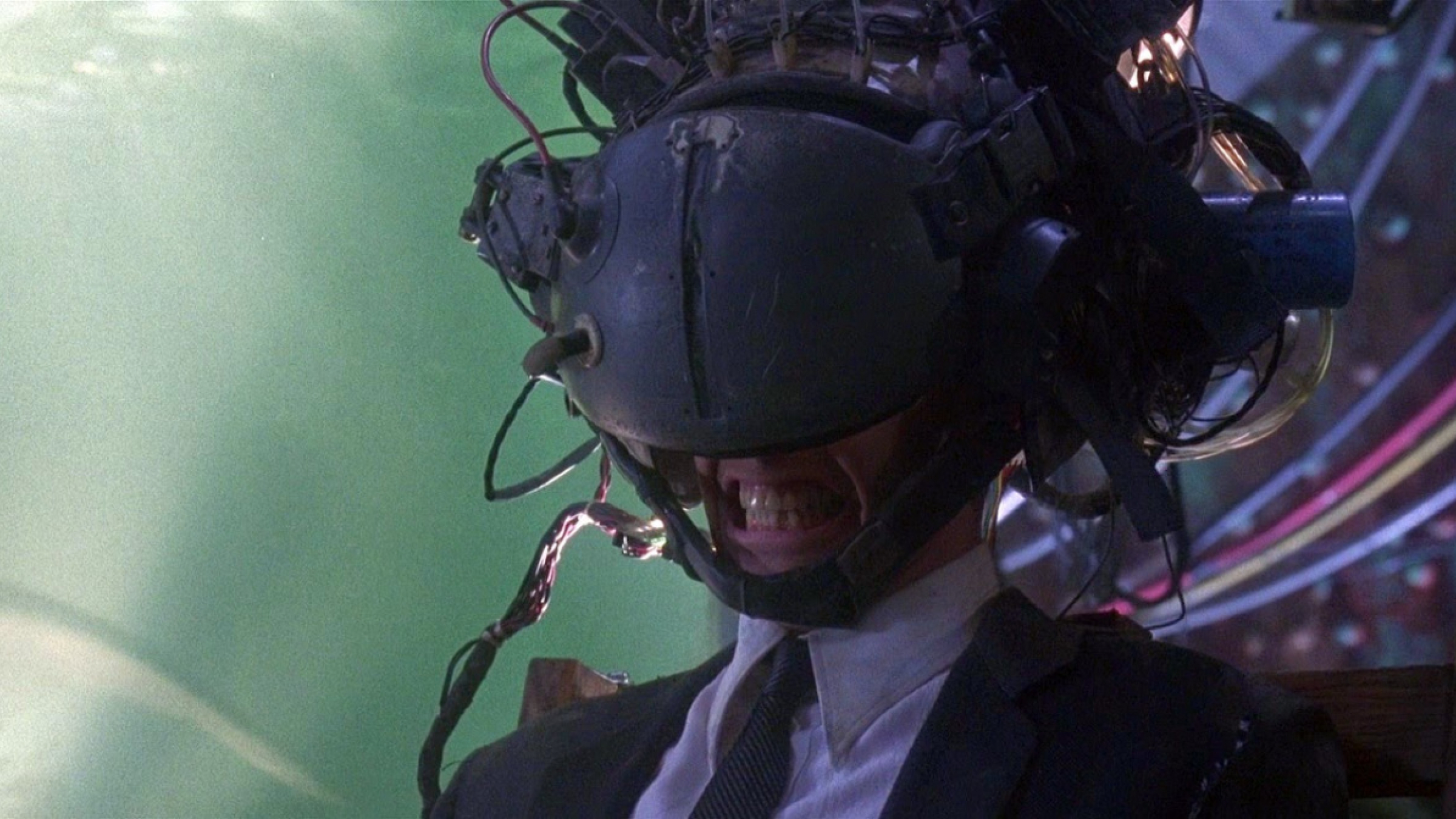
The biggest upgrade from the Meta Quest, however, is the complete lack of hand-held controllers and the reliance on physical gestures instead. Apple’s equivalent already has this, but the Meta VR Glasses offer the chance to use these flicks and pinches without feeling like you’re in a Saw trap.
The initial adjustments seem pretty easy, between switchable nose pads of different sizes and lenses you can slide left and right to ensure they’re at the correct distance. There’s no official info on what to do if you wear glasses just yet, but some leaks out there suggest prescription lens capability is the plan. Tiny cameras alongside the glasses' stems capture minor movements, like using your thumb to imitate scrolling on a touch remote, or pinching an invisible button, which in turn trigger and toggle menus affixed to the space around you. The cameras on the front re-create your regular vision, with a bit of a catch. The world around you gets noticeably noisier (as in, filled with digital noise) and the frame rate doesn’t exactly sync up with fluorescent lightbulbs, so you might see a bit of a flicker when looking past the floating UX at actual surfaces.

Navigating the real world will still probably be a challenge, and the tech’s hologram features (and spatial audio) for video calling weren’t part of the demo. However, Meta VR Glasses feel aimed at sitting down to watch movies and TV rather than augmenting reality. With its 5K display made of micro OLED panels, 37 pixels per degree, and Dolby Vision enhancements, you’re getting a pretty high-quality image, and navigating it is gamified too. Once you sync your eye movements to the cursor, simply looking at an app icon will light it up. Just pinch to select. But what about the actual offerings? Well, that’s where things get interesting.
In addition to all your streaming favorites (Prime Video, YouTube, DIRECTV, AMC+, Crunchyroll, Plex, and vitally, Tubi), Meta has teamed up with IMAX to bring the world of full-frame, 1:43:1 IMAX movies to your headset. Currently, this is poised to be the only way to watch something like The Odyssey in its native aspect ratio outside of a handful of cinemas. Sadly, that option wasn’t available during our limited tech demo, but it sets Meta VR Glasses apart even from Blu-ray and UHD, which only expand to the size of your HD television — a paltry 16:9. With films like The Odyssey, Sinners and Dune: Part Three reflecting an increased demand for the format, which can’t fully be met, this is the next best thing.
But what does actually watching a movie in one of these look like? Well, you have a couple of options. For most films, a screen pops up at a certain distance, which you’ll eventually be able to move back or forth. This feature wasn’t yet available, leaving part of the screen outside the glasses’ field of view, which isn’t ideal, but it’s still early days since the product is several months away from release. Your second option, for select films and experiences, is an “Immersive Cinema” virtual reality viewing room by ILM, built in sync with the movie itself. For this Disney+ demo, I picked Avengers: Infinity War — specifically, the scene where Thor harnesses the power of a dying star to forge his new hammer, Stormbreaker. If you’ve ever fantasized about watching a movie while seated in a grungy space factory as lava splashes from around the screen, you’re in luck. For Marvel and Star Wars offerings, environments like Tatooine and Avengers Tower appear to be in the works.

The 3D isn’t too bad either (as evidenced by a short clip of Doctor Strange in the Multiverse of Madness), though the effect is no more or less immersive than most current 3D television sets. Upon launch, 3D offerings will be available from the likes of HBO Max, Paramount+ and Peacock. However, where things get really novel is the switch from movies to sports, where you have the option of not just watching your game of choice with a 180-degree field of view — in this case, Game 4 of the 2026 NBA finals; go Knicks — but sitting in a variety of courtside seats and glancing around. This isn’t magic; the folks at Meta had cameras appropriately placed to capture the effect, so future games will have to be equipped for this sort of broadcast if you want to, say, wave at Spike Lee as he jumps around euphorically. Then again, between the NBA finals and the FIFA World Cup, if this summer has proved anything, it’s that sports are a social event, so closing yourself off this way might at best be a backup for plans that fall through.
The speakers on the glasses — which you can control using tiny buttons along the bottoms of the stems — provide a fairly immersive surround sound experience courtesy of Dolby Atmos. This comes in handy for playing music-based games like Beat Saber, one of 75 built-in games available at launch (this particular version was enhanced for the device’s handsfree capabilities) in addition to the XBOX Cloud Gaming, i.e. streaming games directly to your headset. You also have the option of scrolling social media, and typing on a nifty keyboard projected on flat surfaces in front of you, as you look down at your digital ghost hands and their spectral glow. The novelty will probably wear off after a while, but at first, it’s pretty thrilling if you’ve never used this kind of technology before — which appears to be the target market for Meta VR Glasses. Of course, there’s a work capability too; you can mirror your Mac or PC into this virtual space, either wirelessly or via USB-C.
On the other hand, the device’s $1,299.99 price tag — more than a solid TV and Blu-ray player combined — might be a deterrent to the average consumer who hasn’t yet dipped their toe into VR. That is, unless Meta plans to roll out highly involved tech demos for every potential buyer. The only way to be remotely convinced of the technology is to experience it for yourself, which a re-creation on a flat screen (say, a YouTube video) can’t fully convey. There’s a candy store feeling to wearing one of these and turning around to see a fully (or semi) rendered space behind you, waiting to be filled.

There are kinks that still need to be worked out by launch, like the glare from light sources behind you leaking into your field of view (perhaps the one downside to opening up those goggles), but a head tilt here or there can probably solve that issue. Also not part of the tech demo was the ability to re-orient where exactly in your horizontal field of view a given screen appears, but this was something Meta’s engineers demonstrated for us on the fly, with the promise that we’d eventually be able to do it ourselves. Much like legs in the Metaverse, it’s coming, baby.
Look, it can be hard to trust big tech in our increasingly dystopian world, and who knows what data this particular chapter of the company will try to harness or sell. But the lineup of streaming services and viewing features on offer makes Meta VR Glasses one of the more intriguing developments in the field if you’re unsure about stepping into virtual spaces. Compared to existing devices on the market, the openness of the design — which still allows you to peek out from time to time and go back to the real world pretty easily — makes for the kind of compromise that fence-sitters like myself might just be able to accept. If nothing else, it’s more convenient, and slightly less embarrassing, than buying a scalped IMAX ticket on eBay.
Sumber: IGN Tech Articles